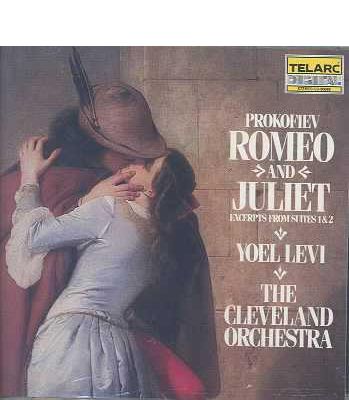
|
|
|
01 |
Montagues and Capulets |
Cleveland Symphony Orchestra |
|
|
05:19 |
|
|
02 |
The Child Juliet |
Cleveland Symphony Orchestra |
|
|
04:08 |
|
|
03 |
Folk Dance |
Cleveland Symphony Orchestra |
|
|
04:21 |
|
|
04 |
Mask |
Cleveland Symphony Orchestra |
|
|
02:16 |
|
|
05 |
Friar Lawrence |
Cleveland Symphony Orchestra |
|
|
02:45 |
|
|
06 |
Dance |
Cleveland Symphony Orchestra |
|
|
02:01 |
|
|
07 |
Romeo & Juliet |
Cleveland Symphony Orchestra |
|
|
07:55 |
|
|
08 |
Death of Tybalt |
Cleveland Symphony Orchestra |
|
|
04:41 |
|
|
09 |
Romeo at Juliet's Before Parting |
Cleveland Symphony Orchestra |
|
|
08:13 |
|
|
10 |
Dance of the Antilles Girls (Suite 2, No. 6) |
Cleveland Symphony Orchestra |
|
|
02:11 |
|
|
11 |
Romeo at the Grave of Juliet |
Cleveland Symphony Orchestra |
|
|
06:12 |
|
| Location |
Telarc Collection |
| Disc 1 |
: CD-80089 |
|
| Studio |
Severance Hall, Cleveland, Ohio |
| Catalog |
CD-80089 |
| Packaging |
Jewel Case |
| Recording Date |
10/24/1983 |
| Spars |
DDD |
| Sound |
Stereo |
|
| Classification: |
TELARC CLASSICAL |
|
| Composer/Artist |
Sergei Prokofiev (1891 - 1953) |
|
|
It took Tchaikovsky to show Russian audiences that music for
the ballet did not need to be of the mild, self-effacing ilk
that had been the norm for centuries. But the two Russian
composers who were to learn Tchaikovskys lessons best, and
who were to add their own brilliant manifestos to the
provocative genre, both built their reputations outside of
their native land. Igor Stravinsky and Sergei Prokofiev made
their marks as collaborators for the dance while working in
Western Europe with the great Diaghilev, his Ballet russes,
and the master choreograohers and scenic designers in that
legendary entourage.
It has been claimed that Prokofiev, the virtuoso pianist,
longed to concentrate his creative energies on opera, which
he is said to have considered the highest of art forms. Be
that as it may, by the time the 41- year-old composer
resettled in Russia after fourteen years abroad, he was
known across the Continent and in America as a purveyor of
his own brittle, exotic works for the piano, and as a
composer of ballet scores, including Chout, Le pas dacier,
The Prodigal Son, and Sur le Borysthène (now the Dnieper
River, in the Ukraine).
Soviet cultural policies aside, it is not at all surprising
that, having decided to go home, Prokofiev had to
reaccilimate himself to his countrymens ways. The composer
wrote in his Autobiography that the Russians ""like long
ballets which take a whole evening; abroad the people prefer
short ballets... This difference of viewpoint arises from
the fact that we attach greater importance to the plot and
its development; abroad it is considered that in ballet the
plot plays a secondary part, and three one-act ballets give
one the chance to absorb a large number of impressions from
three sets of artists, choreographers and composers in a
single evening.""
Still, that does not fully explain why Prokofiev, dealing
with the Kirov Theater to present a new ballet score,
decided on Romeo and Juliet. Surely he knew Berlioz
dramatic symphony, Gounods opera and, more crucially,
Tchaikovskys overture-fantasy, all on the same story - but
precedents, however effective, are not enough to justify
what appears to have been the composers conscious decision
to move out of the musical arena in which his career had
been built.
His motivation was musical. In his Autobiography, Prokofiev
listed the four primary elements in his own musical style:
the classical, the modern (including what he called
""crudity""), the motoric or toccata, and the lyrical. ""As
time went on;"" he wrote, ""I gave more and more attention to
(the lyrical) aspect of my work."" The more he considered the
possibilities of a Romeo and Juliet ballet score, the more
he saw that such a project would allow him to capitalize on
these lyrical aspects, as well as to incorporate the other
elements which had been integrated into his creative
signature. He would have to face criticism for mixing such
seemingly disparate elements as ""crudity"" and classicism;
only the more astute listeners realized upon first hearing
the ways in which Prokofiev had unified his lengthy score
through the use of recurring motifs - not merely themes to
signify the characters arrivals onstage, but motifs to
suggest emotions, changing situations and fate. There are
many who contend that Prokofievs Romeo and Juliet is, quite
simply, the greatest ballet score ever written.
The course of this Romeo and Juliet did not run smooth. The
Kirov Theater changed its collective mind about the project,
so Prokofiev took his idea to Moscows Bolshoi Theater,
where he was led to expect a premiere late in 1935. The
composer delivered the score at the end of the summer of
that year, only to be told that he had written music that
was impossible to dance to, and to have his contract broken.
Furthermore, Prokofiev had offended the sensibilities of
academia. In the belief that ""li
Companies, etc.
Phonographic Copyright (p) – Telarc Records
Copyright (c) – Telarc Records
Manufactured By – Matsushita Electric Ind. Co., Ltd.
Recorded At – Severance Hall
Credits
Art Direction – Ray Kirschensteiner
Edited By – Elaine Martone
Engineer – Jack Renner
Photography By [Cover Photo] – John Watt (7)
Producer – Robert Woods (2)
Notes
Very early Japan-for-US pressing with hand etched matrix numbers in the mirror ring.
Issued in a smooth sided jewel case with a gray tray with "Patents pending" on the back.
Recorded in Severance Hall, Cleveland on October 24, 1983
℗ © 1984 TELARC® RECORDS
Made in Japan