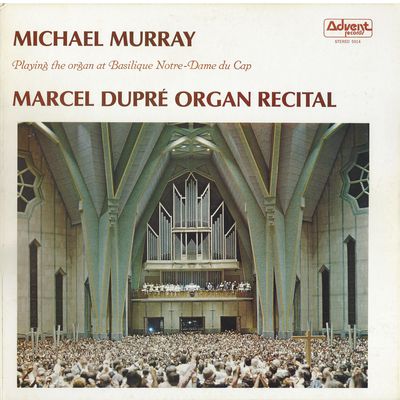
|
|
|
|
|
|
21:05 |
|
|
01 |
Cortege et Litanie, Op. 19, No. 2 |
Marcel Dupré (1886 - 1971) |
|
|
06:52 |
|
|
02 |
Choral et Fugue, Op. 57 |
Marcel Dupré (1886 - 1971) |
|
|
07:24 |
|
|
03 |
Musette, Op. 51 |
Marcel Dupré (1886 - 1971) |
|
|
02:37 |
|
|
04 |
I am Back but Comely, Op. 18 |
Marcel Dupré (1886 - 1971) |
|
|
04:12 |
|
|
|
|
|
14:49 |
|
|
05 |
Prelude and Fugue in G Minor, Op. 7, No. 3 |
Marcel Dupré (1886 - 1971) |
|
|
07:14 |
|
|
06 |
Elevation, Op. 32, No. 1 |
Marcel Dupré (1886 - 1971) |
|
|
03:00 |
|
|
07 |
Final, Op. 27, No. 7 |
Marcel Dupré (1886 - 1971) |
|
|
04:35 |
|
| Purchase Date |
3/17/2017 |
| Location |
Telarc Collection |
| Disc 1 |
: Advent 5014 |
|
| Catalog |
Advent 5014 |
| Packaging |
LP Jacket |
| Recording Date |
1976 |
| Spars |
AAA |
| Sound |
Stereo |
| Vinyl Color |
Black |
| RPM |
33 |
|
| Classification: |
ADVENT RECORDS |
|
| Composer/Artist |
Michael Murray (1943 - ) |
|
|
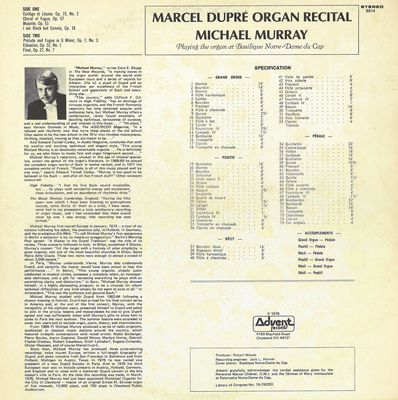
"Michael Murray," writes Enos E. Shupp the organ world: around the world with European tours and a series of records for Advent. [He is] a pupal of Dupre and an interpreter par excellence of the French School and apparently of Bach and every-thing e1se...''
''This country,'' adds Clifford F. Gil more in High Fidelity, "has no shortage of virtuoso organists, and the French Romantic repertory has long remained popular with audiences here, but Michael Murray offers a combination, rarely found anywhere, of dazzling technique, seriousness of purpose, and a real understanding of and interest in this music...'' "He p1ays,''says Vernon Gotwals in Music, The AGO/RCCO Magazine, "in a relaxed and rhythmic way that turns these pieces of the old school (that seems to be the new school in the 70's) into timeless masterpieces, thrilling, mystical, moving as they are meant to be . . .''
And Edward Tatnall Canby, in Audio Magazine, concludes that with his surefire and exciting technique and elegant style, ''This young Michael Murray is an absolutely remarkable organist. „ „ He is definitely, for us, we who listen to music first and organ finger work second.''
Michael Murray's repertoire, unusual in this age of music specialists, covers the gamut of the organ's literature. In 1968-69 he played the complete organ works of Bach in twelve recitals, and in 1 971 the complete works of Franck. ''Rarely is all of this music played well by one man,'' asserts Edward Tatnall Canby. ''Murray is too good to be believed in his Bach - and after all that French stuff!'' Other reviewers concurred:
High Fidelity: '' I find his first Bach record irresistible, too . . . he plays with wonderful energy and excitement, clean articulation, and an abundance of rhythmic drive„''
The Music Review, Cambridge, England: "During the fifty years over which I have been listening to gramophone records, some thirty of them as a critic, I have never, never had in my possession a truly satisfactory recording of organ music, and l had concluded that there would never be one. I was wrong: that recording has now arrived.''
Michael Murray first toured Europe in January 1973 - a tour of six nations following his debut, the previous July, in Holland. In Germany said the prestigious Die Welt, ''To call Michael Murray's first appearance in Berlin a sensation is by no means an exaggeration.'' Berlin's Morning Post agreed: ''A Master in the Grand Tradition'' was the title of its review. Three concerts followed in Italy. In Milan, exclaimed II Giorno, Murray's concert ''hit the target with a formula of utter simplicity: a great organist, and one of the most beautiful churches in Milan, Santa Maria delle Grazie. These two items were enough to attract a crowd of about 2,000 people."
In Paris, ''Murray understands Vierne. Murray also understands Dupre, and certainly, the master would have been proud to hear this performance . . .'' In Beirut, ''This young organist, already justly celebrated in musical circles, possesses a complete talent, an incomparable technique, and a gift for recreating everything he plays with an astonishing clarity and distinction.'' In Bern, "Michael Murray showed himself, in a highly demanding program, to be a virtuoso for whom technical difficulties of any kind simply do not seem to exist at all.'' In Amsterdam, ''This was the authentic and genuine Bach.''
Michael Murray studied with Dupre from 1962-64 following a chance meeting in Detroit. Dupre had arrived for his final concert series in America and, at the end of the first concert, Murray, with the intrepidity of his eighteen years, presented himself to Dupr6 and asked to join in the private lesions and masterclasses he was to give. Dupre agreed and was sufficiently taken with Murray's gifts to allow him to come to Paris the next summer. The summer lessons were extended to cover two years and to include organ, piano, theory, and improvisation.
From 1969-71 Michael Murray produced a series of radio programs, syndicated to classical l music stations around the country, which featured in-depth conversations with noted artists: Nadia Boulanger, Pierre Boulez, Aaron Copland, Gerald Moore, Marilyn Horne, Dietrich Fischer-Dieskau, Robert Casadesus, Erich Leinsdorf, Eugene Ormandy, Olivier Messiaen, and of course Marcel Dupre.
Since then, Michael Murray has produced three prize-winning recordings, twice-toured Europe, written a full-length biography of Dupre, and given concerts from San Francisco to Baltimore and from Holland, Michigan to Austin, Texas. In 1975, he was named vice president of a new Dupre Society in Paris. And in 1976, his third European tour was to include concerts in Austria, Holland, Germany, and England and to close with a memorial Dupre concert at the late master's villa in Paris. At the time this recording was made, in March, 1976, Michael Murray had just been appointed M0nicipal Organist for the City of Cleveland - master of an original Ernest M. Skinner organ of five manuals, 10,000 pipes, and 150 stops in Cleveland Public Auditorium.